


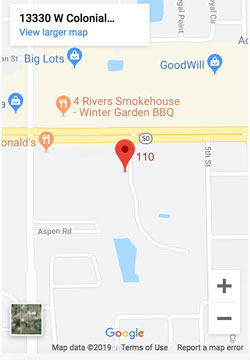
Main Office
13330 W Colonial Drive Suite 110, Winter Garden, FL 34787
Phone: (407) 982-4321
Business law touches nearly every decision an owner makes, from the day the company is formed to the day it’s sold. An Orlando business lawyer helps at each stage: choosing and forming the right entity, drafting the contracts that govern relationships with customers, vendors and partners, protecting the brand, and stepping in when a dispute threatens the company.
Legal Counsel, P.A. works with entrepreneurs, closely held companies and established businesses across Orlando and Central Florida. If you’re looking for a business lawyer Orlando companies can meet with in person, our Orlando office is on Shader Road, and we also meet by phone and video. We act as outside counsel for owners who don’t have a lawyer on staff, which for most small businesses means one firm that knows the company, its contracts and its people.

Call Legal Counsel, P.A. at 407-982-4321 for a free consultation
with an Orlando business attorney.
One of the first decisions a new business faces is how to structure itself, and the choice carries real consequences for liability, taxes and control. Florida owners most often form a limited liability company under the Florida Revised Limited Liability Company Act, a corporation under the Florida Business Corporation Act, or a nonprofit under what the Legislature renamed in 2026 the Florida Nonprofit Corporation Act. The right structure depends on how many owners there are, how profits will be shared, how the business will raise money, and how the owners want to be taxed. We help you determine which entity fits before anything is filed, because changing it later can be costly.
Getting this right at the start costs far less than restructuring later. Florida’s LLC and corporation statutes fill in default rules whenever the owners haven’t written their own, and those defaults are rarely what a particular business would have chosen. A clear operating agreement or shareholder agreement, signed before a disagreement arises, prevents a surprising share of the disputes that later land in court.
Formation is only the start. Every Florida LLC and corporation must file an annual report with the Division of Corporations between January 1 and May 1. A report filed late carries a $400 late fee for LLCs and for-profit corporations, and a company that hasn’t filed by the third Friday in September is administratively dissolved the following week. If you do business under a name other than your company’s legal name, Florida also requires a fictitious name registration, and an unregistered business can’t bring a lawsuit until it complies. We help owners keep these filings current so the company’s protections stay intact.
The most effective thing a business can do to avoid litigation is to use clear, well-drafted contracts. A strong agreement spells out what each party agrees to do, defines what happens if something goes wrong, sets out the damages or other remedy available, and often decides who pays the legal fees in a dispute. Florida generally requires each side to pay its own attorney’s fees unless a contract or statute says otherwise, so the fee clause in your agreement can decide whether a claim is worth pursuing.
Owners regularly discover, too late, that a handshake deal or a borrowed template left them exposed on the one point that ultimately mattered. Common trouble spots include supply and service agreements, non-compete and non-disclosure clauses, partnership and buy-sell arrangements, and the sale or purchase of a business. A short review before you sign is far less expensive than untangling the consequences afterward. Our Orlando business contract attorneys handle that review, and draft new agreements that start in your favor.
Florida enforces restrictive covenants more readily than many states, as long as the covenant is in a signed writing, protects a legitimate business interest, and is reasonable in time, area and line of business. Since 2025, the CHOICE Act also allows longer covenants for highly paid employees if strict notice rules are followed. If a former employee or partner violates an agreement, our non-compete dispute lawyers can move to enforce it.
At some point you may buy another company, sell your own, or bring in a new owner. These transactions can be structured as an asset sale or a sale of stock or membership interests, and the structure changes which liabilities follow the business. We review the deal against your goals, handle due diligence, draft or review the purchase agreement, and prepare the closing documents. When real property is part of the deal, our Orlando real estate attorneys handle that side of the transaction.
Even with solid contracts, disputes happen. A partner wants out, a customer refuses to pay, a former employee takes your client list, or a vendor doesn’t perform. When that happens, the first step is usually a well-framed demand letter or mediation, which resolves many disputes faster and at lower cost than a lawsuit. When a case can’t be settled, we pursue or defend the claim in civil court, and having a lawyer who already knows the company, its contracts and the potential damages is a real advantage.
Our business litigation attorneys represent companies pursuing claims and those defending them, including partnership disputes, shareholder conflicts and breach of contract claims. We look for the remedy that serves the business, whether that’s a payment, an injunction, or a clean exit from a relationship that isn’t working.
Michele Diglio-Benkiran founded the firm and has practiced business and real estate law since 1999. She’s a member of The Florida Bar’s Business Law Section and the Orange County Bar Association. Richard Sierra is a commercial litigation and bankruptcy lawyer with more than three decades of experience, admitted to practice in Florida’s Middle and Northern District federal courts and the Eleventh Circuit Court of Appeals.
That pairing is the point, and it’s one team. The contract we draft today is written by lawyers who know how contracts get tested in court, and if one is tested, the same firm is ready to enforce it. Results matter. We offer a free consultation, and pay later options are available for qualifying clients.
We represent companies throughout Orlando, Orange County and Central Florida from our Winter Garden, Orlando and Seminole offices. Business cases in Orange County are heard by the Ninth Judicial Circuit at the Orange County Courthouse on North Orange Avenue, and federal matters go to the Middle District of Florida’s Orlando courthouse. Business law is one of several practices at our Orlando law firm, which lets us handle the real estate, trademark and litigation sides of a matter without sending you elsewhere.
A small business attorney Orlando owners can sit down with will help you see the risks
before they cost you. The first consultation is free.
A business attorney helps form and structure the company, drafts and reviews contracts, protects the brand, advises on compliance, and represents the business in disputes. The most valuable work is often preventive, done before a problem arises.
It depends on the work. Formation packages and routine contract reviews are often quoted as flat fees, while litigation and complex transactions are usually billed on scope. We explain how we’ll bill, in writing, before we start.
Look for an attorney who handles both transactions and litigation, explains your options in plain language, and responds quickly. Ask how they’ll help you avoid a dispute, not only how they’d handle one, since prevention is where a business lawyer adds the most value. Ask how they bill, who will actually do the work, and whether they’ve handled businesses of your size and industry.
More often than owners assume. Small businesses tend to reuse contracts and skip entity planning, which is exactly where costly problems start. A modest investment in the right structure and clear agreements prevents disputes that are far more expensive to resolve later.
It depends on ownership, liability, taxes and how you plan to raise money. LLCs offer flexibility and simpler governance for most small businesses, while corporations can suit companies planning to bring in investors. We’ll walk you through the tradeoffs before you file.
Not fully. Registering an entity or a fictitious name with the state doesn’t give you trademark rights, and it doesn’t stop another business from using a similar brand. Trademark rights come from using the name in commerce and are strengthened by registration.
Not if your company was formed in the United States. FinCEN’s rules now exempt domestic companies from federal beneficial ownership reporting. Foreign companies registered to do business in the U.S. may still have to file.
Often without a trial. Many disputes are resolved through a demand letter, negotiation or mediation, which is usually faster and less costly than court. Litigation is available when a matter can’t be settled and the business’s interests require it.
An NDA is a contract that restricts how someone can use or share your confidential information. Florida courts generally enforce NDAs that are reasonable and protect a legitimate business interest, such as trade secrets or customer information.
Before a problem exists: when forming the company, before signing a significant contract, when bringing on a partner, or when planning to buy or sell a business. Failing that, call as soon as a dispute appears, while you still have options.
The right Orlando business attorneys for your company will understand your industry, handle both transactions and disputes, and give you straight answers about cost. We’re happy to talk through your situation at a free consultation so you can decide whether we’re the right fit.
Your business deserves counsel that knows it well. Call Legal Counsel, P.A. at 407-982-4321 or use our contact form to schedule your free consultation with an Orlando business attorney.

WE VALUE RELATIONSHIPS
Most of our clients come to us by referral and word of mouth (not advertising).

COMMITMENT TO EXCELLENCE
The Legal Counsel team is committed to serving all clients with excellence and professionalism.

EXPERIENCE MATTERS
Decades of Representation.

CUTTING EDGE TECHNOLOGY
View your entire case, communicate with us 24/7, review billing statements, documents, etc. on our bank secure, online client portal.