Florida Real Estate Law: Regulations, Rights & Updates | Legal Counsel P.A.
In This Article
-
Understanding Real Estate Law in Florida
- What Florida Real Estate Law Covers
- Types of Property Ownership in Florida
Title Searches and the Florida Real Estate Closing Process
Understanding Real Estate Law in Florida
Buying or selling property in Florida involves more than just signing contracts. It means navigating a detailed set of state laws that govern how real estate transactions are conducted.
Florida real estate law protects consumers, ensures transparency, and regulates professionals across the Sunshine State.
Knowing these laws helps you:
- Avoid costly disputes
- Protect your investment
- Ensure every transaction complies with state requirements
Why It Matters
Whether you’re a first-time buyer, investor, or real estate professional, understanding Florida’s property laws helps you make informed decisions and avoid costly mistakes. When in doubt, consult a qualified Florida real estate attorney for guidance tailored to your specific situation.
What Florida Real Estate Law Covers
Florida real estate law governs the legal rules and processes involved in buying, selling, leasing, and owning property in the state. It applies to residential and commercial transactions and outlines the rights and obligations of buyers, sellers, landlords, tenants, and investors. These laws regulate everything from contract formation and disclosure requirements to title transfers and dispute resolution. Because Florida has unique regulations related to property disclosures, homestead protections, and closing procedures, understanding how state-specific real estate law works is essential before entering a transaction. Whether you are purchasing a home, selling investment property, or resolving a property dispute, Florida real estate law provides the framework that determines how transactions must be handled and enforced.
Florida real estate law typically covers the following areas:
- Property purchases and sales
-
consult a business contract lawyer
- Seller disclosure requirements
- Ownership rights and title issues
- Closing procedures and deed recording
- Legal remedies for disputes
Types of Property Ownership in Florida
Florida law recognizes several types of property ownership, and each structure affects how property rights, responsibilities, and transfers are handled. Choosing the correct ownership type can impact liability, inheritance, taxes, and decision-making authority. For individuals, ownership structure often depends on whether the property is held alone or with others. For investors, ownership may involve trusts or business entities designed to protect assets and streamline management. Understanding these distinctions is important before purchasing or transferring real estate, as changing ownership structures later can involve additional legal steps and costs. Florida real estate law clearly defines how each ownership type operates and what rights each owner holds.
Common forms of property ownership in Florida include:
- Sole ownership, where one individual holds full legal title
- Joint tenancy, which includes the right of survivorship
- Tenancy in common, allowing owners to hold unequal shares
- Trust ownership, often used for estate planning
- Corporate or LLC ownership, commonly used by investors
Each option carries different legal and financial consequences that should be reviewed carefully before finalizing a transaction.
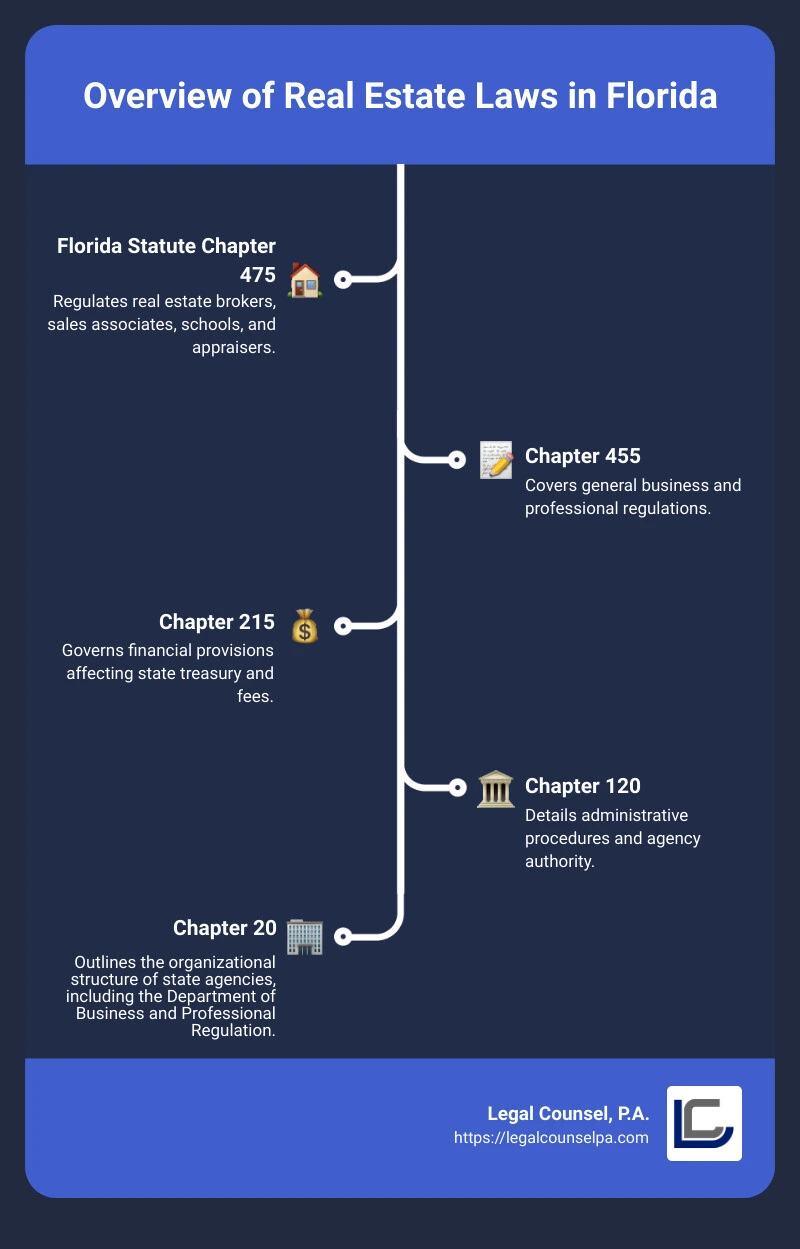
Quick Reference: Core Florida Real Estate Laws
| Law / Statute | Focus Area | What It Regulates | Who It Affects |
| Chapter 475 | Real Estate Professionals | Sets the rules for real estate agents, brokers, and appraisers — including how they’re licensed and how they must treat clients | Agents, brokers, appraisers |
| Chapter 455 | Professional Regulation | Explains the general rules all licensed professionals in Florida must follow, such as honesty, fairness, and disciplinary actions for violations | All licensed professionals |
| Chapter 120 | Administrative Procedures | Details how government agencies create and enforce laws that affect real estate | State agencies, professionals |
| Chapter 20 | State Agency Structure | Describes how Florida’s Department of Business and Professional Regulation (DBPR) and Real Estate Commission (FREC) are organized and operate | DBPR, FREC |
| Chapter 215 | Financial Management | Covers how Florida manages public money, fees, and state financial procedures related to real estate and business regulation | State and financial entities |
Key Real Estate Laws in Florida
When dealing with real estate law in Florida, it’s crucial to know the key laws that govern transactions and property rights. Let’s dive into the main ones:
Florida Real Estate Settlement Procedures Act (RESPA)
RESPA protects buyers and sellers by ensuring full transparency in property transactions.
Key points:
- Closing cost disclosure: Lenders must provide an estimate of all closing costs within three days of receiving a loan application.
- No hidden fees: RESPA prohibits kickbacks, referral fees, and unearned charges.
- Consumer protection: Both buyers and sellers benefit from clearly itemized costs and ethical standards in every transaction.
Chapter 475: Real Estate Brokers, Sales Associates, Schools, and Appraisers
Chapter 475 of the Florida Statutes is fundamental for anyone involved in real estate. It outlines the rules for brokers, sales associates, and educational institutions.
Key Points:
- Brokerage Relationships: Real estate professionals must disclose their relationship with clients, whether they are single agents, transaction brokers, or have no brokerage relationship.
- Transaction Brokerage: Most transactions in Florida are handled by transaction brokers, who provide limited representation to both parties without a fiduciary duty.
- Required Disclosures: Agents must disclose all known facts that materially affect the value of a property and are not readily observable.
Property Ownership and Rights in Florida
Owning property in Florida means holding several fundamental rights protected under state law:
- Right to use and enjoy: Owners can use their property as they wish, within zoning and environmental rules.
- Right to develop and improve: Property owners can build or modify structures with proper permits.
- Right to privacy: Owners have control over who enters their property.
- Right to exclude: Owners can prevent unauthorized access or use.
These rights protect homeowners and investors from misuse, trespass, and unfair interference.
Adverse Possession (“7-Year Property Law”)
Florida recognizes adverse possession, commonly called the “seven-year rule.” This allows a person to claim ownership of property under strict conditions:
- Continuous, open possession for seven years
- Filing a return with the county appraiser
- Paying property taxes during that time
Adverse possession cases are rare but important to understand. They can arise when land boundaries are unclear or properties are abandoned.
Understanding these laws helps ensure that real estate transactions are conducted legally and fairly. Next, let’s look at recent changes and updates in Florida real estate law. Current adverse possession laws in Florida, including adverse possession Florida 2024 updates, make it critical for property owners to monitor land use and tax records closely.
Recent Changes and Updates in Florida Real Estate Law
Florida’s legislature introduced several updates to improve transparency, security, and fairness in real estate transactions:
- Witness Address Requirement
By January 1, 2024, all real estate documents including deeds, mortgages, easements, and affidavits now require witnesses to include their printed name and address.
- County Recording Notification Service
By July 1, 2024, all Florida counties must offer a free recording notification service, alerting property owners to new filings under their name or parcel number – a major tool for fighting title fraud.
- Quiet Title Actions for Fraudulent Deeds
Under Florida Statute § 65.091, owners can now file for expedited quiet title actions to reclaim property if a deed was fraudulently executed.
- Standardized Quitclaim Deed Form
Florida now requires a consistent quitclaim deed format with mandatory fields for clarity and fraud prevention.
- Lee County ID Verification Pilot Program
Lee County is testing a system requiring government-issued ID for deed recording, aiming to reduce fraudulent property transfers statewide.
Title Searches and the Florida Real Estate Closing Process
The closing process in Florida real estate transactions is designed to confirm legal ownership and protect all parties involved. Before a sale is finalized, a title search is conducted to verify that the seller has clear ownership and that no unresolved liens, claims, or legal defects exist. Once the title is reviewed, title insurance is typically issued to protect buyers and lenders from future disputes related to ownership. Florida law also requires that deeds and related documents be properly recorded in county records to make ownership legally enforceable. Errors during this process can delay closings or lead to costly legal issues after the sale.
Key steps in the Florida real estate closing process include:
- Conducting a title search to identify ownership issues
- Resolving liens or title defects before closing
- Issuing title insurance for buyer protection
- Reviewing closing disclosures and settlement statements
- Recording the deed and mortgage with the county
Licensing and Regulation of Real Estate Professionals
The Florida Real Estate Commission (FREC) and DBPR regulate agents, brokers, and appraisers. Here’s what professionals must do to stay compliant:
- Complete 63 hours of pre-licensing coursework
- Pass the Florida Real Estate Sales Associate Exam
- Submit fingerprints for a background check
- Apply for a license via DBPR
Additional regulations include:
- Referral Fees: Only allowed through licensed brokers.
- Designated Sales Associate Law: Allows dual representation in high-value commercial transactions.
- Title Opinions: Only licensed attorneys may provide title opinions or legal interpretations.
- Broker Offices: Only brokers may open offices and register them with FREC.
Common Real Estate Legal Issues in Florida
Some of the most frequent legal problems in Florida real estate include:
- Title and boundary disputes
- Unrecorded liens or encumbrances
- Disclosure violations in home sales
- Landlord-tenant eviction conflicts
- Fraudulent conveyances or title theft
If you encounter any of these issues, it’s crucial to consult an attorney before taking further action.
Frequently Asked Questions About Florida Real Estate Law
Can a real estate agent handle closing without an attorney in Florida?
Yes, a licensed title company or real estate agent can facilitate the closing process in Florida. However, only an attorney can provide legal advice, interpret contract terms, or address title defects. If issues arise with the deed, liens, or ownership rights, having a real estate attorney ensures the closing is legally sound and fully compliant with Florida law.
What is the main real estate law in Florida?
The Florida Real Estate Settlement Procedures Act (RESPA) governs transparency and fairness in real estate transactions, requiring disclosure of closing costs and prohibiting kickbacks.
Who regulates real estate in Florida?
The Department of Business and Professional Regulation (DBPR) and the Florida Real Estate Commission (FREC) oversee licensing, rule enforcement, and disciplinary actions.
What are the disclosure laws for home sellers in Florida?
Sellers must disclose all known facts that materially affect property value and aren’t visible to buyers, including structural defects, flood risks, or past repairs.
Are verbal real estate agreements valid in Florida?
No. Under the Statute of Frauds, all real estate contracts must be in writing to be enforceable.
How can I protect my property from title fraud?
Enroll in your county’s free recording notification service to receive alerts about any document recorded in your name.
What disclosures are required when selling property in Florida?
Florida law requires sellers to disclose any known facts that materially affect the value of the property and are not easily visible to buyers. This includes structural issues, roof leaks, plumbing or electrical problems, pest infestations, water damage, and flood history. Failing to disclose these issues can result in legal liability or rescission of the sale. The goal of these disclosure laws is to ensure honesty and transparency in every real estate transaction.
When to Contact a Florida Real Estate Attorney
While you can research Florida’s property laws online, legal guidance becomes essential when:
- Buying or selling real estate worth significant value
- Facing disputes or unclear title issues
- Drafting or reviewing contracts
- Dealing with fraud, liens, or eviction actions
Contact Legal Counsel, P.A. for Real Estate Law Guidance
At Legal Counsel, P.A., we help Floridians navigate every aspect of property law — from contract review and closings to complex disputes and title claims.
Our experienced attorneys combine deep legal knowledge with a commitment to clear communication and client-first service. Whether you’re buying your first home or managing multiple investment properties, we’ll ensure your interests are protected at every step.
Talk to an Attorney Today and gain peace of mind knowing your Florida real estate transaction is handled by professionals who know the law inside and out.
Disclaimer: This article is for informational purposes only and should not be taken as legal advice. Consult a qualified Florida real estate attorney for guidance specific to your situation.