


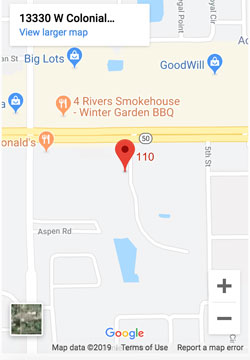
Main Office
13330 W Colonial Drive Suite 110, Winter Garden, FL 34787
Phone: (407) 982-4321
Your business name, logo and slogan carry the reputation you’ve worked to build. An Orlando trademark lawyer at Legal Counsel, P.A. helps you choose a brand you can protect, register it at the state and federal level, and defend it when someone copies it.
A trademark is a form of intellectual property that identifies the source of your goods; a service mark does the same for services. Both can be a word, a name, a logo, a slogan or even a sound, and both can become one of the most valuable things a company owns. They’re also easy to lose: a mark that’s too descriptive may never be registrable, and a mark that’s too close to someone else’s can force a rebrand after you’ve already printed the signs.
Legal Counsel, P.A. is a business law firm, and our Orlando trademark attorneys handle trademark law and service mark work for companies across Orlando and Central Florida, at the state and federal levels. A trademark lawyer Orlando businesses work with at our firm treats the brand as part of the business plan, not a filing to get out of the way.
Call Legal Counsel, P.A. at 407-982-4321 for a free consultation
with an Orlando trademark attorney.
The most expensive trademark mistake is choosing a mark someone else already has rights to. Before you file an application, order signage or launch a website, we search the federal register, the Florida register and common-law use to see whether your proposed mark is likely to conflict with an existing one.
A search also tells you how strong your mark is. Invented and arbitrary names are the easiest to protect. Descriptive names (“Orlando Plumbing Services”) are hard to register until they’ve acquired distinctiveness through use, and generic terms can’t be registered at all. Getting the application right the first time matters, because USPTO filing fees aren’t refunded if the application is refused.
One common misconception: forming an LLC or registering a fictitious name with the state doesn’t give you trademark rights. Those filings are public notice only. Your rights in a name come from using it in commerce, and registration makes those rights far easier to enforce.
Federal registration with the USPTO protects your mark across the United States. It gives the public nationwide notice of your claim, creates a legal presumption that you own the mark and have the exclusive right to use it for the listed goods or services, and lets you use the ® symbol. It also gives you the stronger federal claims and remedies available for registered marks, and lets you record your registration with U.S. Customs to stop counterfeit imports.
A federal registration isn’t permanent unless you maintain it. The owner has to file a declaration of continued use between the fifth and sixth year after registration, and a combined declaration and renewal between the ninth and tenth year, then every ten years after that. If a filing is missed and the six-month grace period also passes, the registration is cancelled or expires.
A Florida registration protects your mark within Florida only, but it costs less than a federal filing. The state reviews the application under Florida’s own registrability rules and against marks already in use or registered in Florida, and the mark must already be in use in Florida before you apply. It can make sense for a business that operates only in Florida. Florida registrations are filed with the Division of Corporations, cost $87.50 per class, and last five years, with renewals available for additional five-year terms.
When a brand changes hands, the trademark assignment has to be in writing and transfer the goodwill of the business that goes with the mark. Recording the assignment with the USPTO within three months protects the buyer against a later purchaser. If you’re buying a business or a brand, we review the chain of title before you pay for anything, and our Orlando business attorneys can handle the rest of the transaction.
A license, by contrast, lets another company use your mark while you keep ownership. A well-drafted license agreement sets the territory, term, quality standards and royalties, because a license without quality control can weaken your rights.
As a trademark owner, you’re responsible for policing your mark. If another company uses a name or logo that’s likely to confuse your customers, we typically start with a cease-and-desist letter, which resolves many disputes. When it doesn’t, our business litigation attorneys can pursue a trademark infringement or unfair competition claim. Even an unregistered mark can be enforced in the area where it’s been used, though registration makes the case much stronger.
We also defend businesses that receive a demand letter claiming they’ve infringed someone else’s mark. Those letters often overstate the sender’s rights, and a measured response can avoid a costly rebrand.
Michele Diglio-Benkiran founded the firm and has practiced business and real estate law since 1999, and she’s a member of The Florida Bar’s Business Law Section. Trademark work at our firm sits inside a broader business practice, so the same team can form your company, draft the contracts that use your brand and register the mark itself.
Richard Sierra is a commercial litigation and bankruptcy lawyer with more than three decades of experience, admitted to practice in Florida’s Middle and Northern District federal courts and the Eleventh Circuit. When a brand has to be defended, he’s already on the team. Results matter. We offer a free consultation, and pay later options are available for qualifying clients.
We help startups, restaurants, contractors, retailers, professional practices and established companies throughout Orlando and Central Florida protect their brands. We work from our Winter Garden, Orlando and Seminole offices, and much of the trademark process can be handled by phone, email and video. Trademark work is one part of our Orlando law firm, which also handles corporate formation for new businesses choosing a name.
A trademark attorney Orlando FL business owners can meet with will assess the
risks of using it and how to protect it. The first consultation is free.
It depends on the work. A search and a single-class application are often quoted as a flat fee, plus the government filing fee. Office action responses, oppositions and infringement matters are priced on scope. We’ll give you a quote at your consultation.
A Florida state registration costs $87.50 per class in state filing fees. A federal registration with the USPTO starts at a base fee of $350 per class, with surcharges for incomplete or custom descriptions. Attorney’s fees are separate.
You don’t have to, but legal advice helps you protect your brand from the start. Many applications run into trouble over the description of goods and services, the filing basis or a conflicting mark, and fees aren’t refunded if an application is refused. An attorney also catches problems a do-it-yourself search misses.
Names, logos, slogans, designs and even sounds can be trademarked if they identify the source of your goods or services. Generic terms, merely descriptive terms without acquired distinctiveness, marks likely to be confused with an existing mark, and certain surnames and government insignia can’t be registered.
No. Registering an LLC, a corporation or a fictitious name with the state doesn’t create trademark rights. Your logo and your name are separate marks, and each should be cleared and, ideally, registered on its own.
A federal registration can last indefinitely, as long as you keep using the mark and file the required maintenance documents between the fifth and sixth years, and every ten years after registration. A Florida registration lasts five years and can be renewed.
A federal application usually gets its first review in about four to five months, and many applications that go smoothly reach registration in roughly a year. A Florida state application is examined by the Division of Corporations under Florida’s rules, and the mark must already be in use in Florida when you apply.
A Florida registration may be enough for a business that only operates in Florida, but plans change, and a federal registration protects your brand nationwide. We’ll help you decide which filing fits your business now and later.
Document the use, avoid contacting the other business on your own, and talk to a trademark lawyer. Many disputes resolve with a cease-and-desist letter, and your options depend on who used the mark first and where.
Your brand is worth protecting before someone else claims it. Call Legal Counsel, P.A. at 407-982-4321 or use our contact form to schedule your free consultation with an Orlando trademark lawyer.

WE VALUE RELATIONSHIPS
Most of our clients come to us by referral and word of mouth (not advertising).

COMMITMENT TO EXCELLENCE
The Legal Counsel team is committed to serving all clients with excellence and professionalism.

EXPERIENCE MATTERS
Decades of Representation.

CUTTING EDGE TECHNOLOGY
View your entire case, communicate with us 24/7, review billing statements, documents, etc. on our bank secure, online client portal.